Why Your 3-Day Trial Is Really a 1-Hour Trial
 Simon S
You picked a 3-day trial. Maybe 7. The reasoning was sound: give people enough time to build a habit, hit the paywall when they're hooked, convert.
Here's what we see in the data instead.
Give it a full day and close to a third of trials are already cancelled. The trial length on your paywall said three days, or seven. The user took two hours.
Those are our numbers, from trials we've tracked long enough for the window to have fully elapsed. The exact figure moves around by app, price point, and onboarding. The shape, a cliff in the first hours, is the part that doesn't.
So the trial length is mostly theater. Whatever number you put in App Store Connect, the decision gets made in the first session.
You're not running a 3-day trial. You're running a 1-hour trial with a 3-day billing delay.
The cancel decision happens before the trial does its job
The mental model most teams have is a clock: the user has three days, they explore, the value compounds, and at the end they decide. The data describes something closer to a snap judgment. The user starts the trial, opens the app once, forms an opinion, and if the opinion is "not for me" they go straight to Settings and cancel before they forget. With more than a fifth of trials gone inside two hours, most of the trial window is just a renewal waiting on a decision that was made in the first sitting.
This isn't irrational behavior to design around. It's the default behavior. People know the way you avoid an unwanted charge is to cancel immediately, while you're thinking about it. The subset of users who'll let a trial ride and decide later is small and shrinking.
So the trial isn't a three-day evaluation. It's whatever happens in the first session, and then a coin that's already been flipped.
The first session is the whole trial
If the decision happens in one sitting, the thing that matters is whether the user hits a payoff fast: the moment the app does the thing they downloaded it to do. A meditation app that delivers a session that actually calms someone down. A photo app that produces one edit worth posting. A budgeting app that shows them a number they didn't know.
If that moment is gated behind a long onboarding, a setup flow, a "connect your accounts" step, or a tutorial, you're spending the only window you've got on friction. The screen right after the user starts the trial is doing more work than the entire three-day window, because it's the bridge between "I tapped subscribe" and "the app did something for me." Get the user to a real payoff in that first sitting or the cancel is already in motion.
Practical version: assume the user will form their verdict in one session, and engineer that session so the payoff comes early. Everything else is secondary.
What this does to your acquisition math
Here's where it stops being a product problem and becomes a measurement problem.
If you optimize your Meta, Google, or TikTok campaigns on "trial started," you're optimizing toward a number where more than one in five is already cancelled within hours and close to a third within a day. The ad networks will happily find you more people who start trials. A good chunk of those people are the same-session cancel cohort. You'll scale a metric that doesn't pay rent.
The signal that actually correlates with revenue is the trial that survives those first hours and goes on to convert, and then the subscription that renews. That's the event you want flowing back to the ad networks so their optimization targets the users worth acquiring. The problem is that this event lands hours or days after the install, often originates from your billing provider (RevenueCat, Superwall) rather than your app, and a lot of install-centric attribution setups either can't see it or can't pass it on. So teams default to optimizing on the install or the raw trial start because that's what their pipeline can actually report, and then wonder why blended return on ad spend doesn't move when trial volume does.
Send the trial that survived the first hours, not the one that started
This is the specific thing SignalSeal does about the problem above.
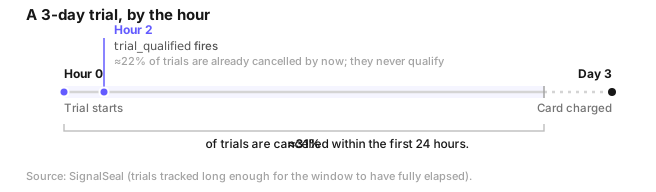
When a rc_trial_started or sw_trial_started event comes in, SignalSeal doesn't immediately forward it to the ad networks as the conversion to optimize on. It waits two hours. If no cancellation or expiration arrives for that subscriber in that window, it emits a derived rc_trial_qualified (or sw_trial_qualified) event, and that is what gets fanned out to Meta's Conversions API, Google Ads, and TikTok's Events API. Same logic for subscription starts: *_subscription_started becomes *_subscription_qualified two hours later if it's still alive.
Two hours isn't arbitrary. It's long enough to clear the impulse-cancel that happens in the same session, before the user has closed the app and moved on. In our data that's about 22% of trial starts: gone inside two hours, never going to count, filtered out before the ad network ever learns about them. The networks then optimize toward people who at least made it past the first sitting, which is a strictly better proxy for "will convert" than "tapped subscribe once."
Trials are where you start, not where you stay
A qualified-trial event still isn't your deepest conversion event, and it shouldn't be the one a mature campaign runs on. But there's a real reason to send it anyway when you're getting going: time.
When you first turn on a campaign, the ad network's optimizer needs conversions to learn from, at some volume and some cadence. If the only event you feed it is "trial converted," you're asking it to wait out the trial before it sees a single data point: three days, seven, sometimes thirty. While it waits, the campaign is flying blind, spending budget against a half-trained model. A qualified-trial event comes back in hours, at several times the volume. That's enough to get the optimizer moving on day one instead of day eight.
So early on, optimize on the qualified trial. It gets you off the ground.
Then move down the funnel. A trial-shaped event sits well upstream of the thing you actually care about, and the distance between "started a trial" and "is still paying three months in" is large: trials that survive two hours still have to survive the trial period, convert to paid, and keep renewing. The further upstream you optimize, the more the network's idea of a good user drifts from your idea of a profitable one. Once the campaign has volume and the conversion data has built up, switch the optimization event to trial-converted, and then, if you can absorb the latency, to renewal or a revenue signal. That's where efficient spend lives. The qualified-trial event becomes the thing you use to spin up new campaigns fast, not the thing the profitable ones are tuned on.
The rule of thumb: optimize on the qualified-trial event to launch a campaign, on trial-converted and renewals to run it. The first buys you speed. The second buys you efficiency.
- The trial length on your paywall is a billing setting, not an evaluation period. In our data, more than one in five trials is cancelled within two hours of starting and close to a third within a day. The decision happens in the first session.
- Front-load the payoff. Get the user to the core value inside the first session, before any optional setup. The screen right after they subscribe matters more than the rest of the trial.
- A longer trial doesn't move the decision later. The cancel isn't a function of time, it's a function of the first session. Extending the trial mostly delays the cancellation you'd have gotten anyway.
- Optimize on trials to launch a campaign, on conversions to run it. A qualified-trial event gets the ad networks learning in hours instead of waiting out a 3-to-30-day trial, so it's the right signal to start on. But efficient spend lives further down the funnel: once a campaign has volume, move the optimization event to trial-converted and renewals. That needs attribution that ingests revenue events from wherever they live and can send them server-side.
The short version: build the first session like it's the whole trial, and measure to the conversion that survives it, not the trial start that doesn't.
Want your ad spend optimizing on trials that cleared the first hours instead of trials that cancel by morning? Start for free. No credit card required.